Engineering2 min read
Migrating IDs to Object IDs
We've transitioned to Object IDs across all entities for better readability and scalability.
GBy George
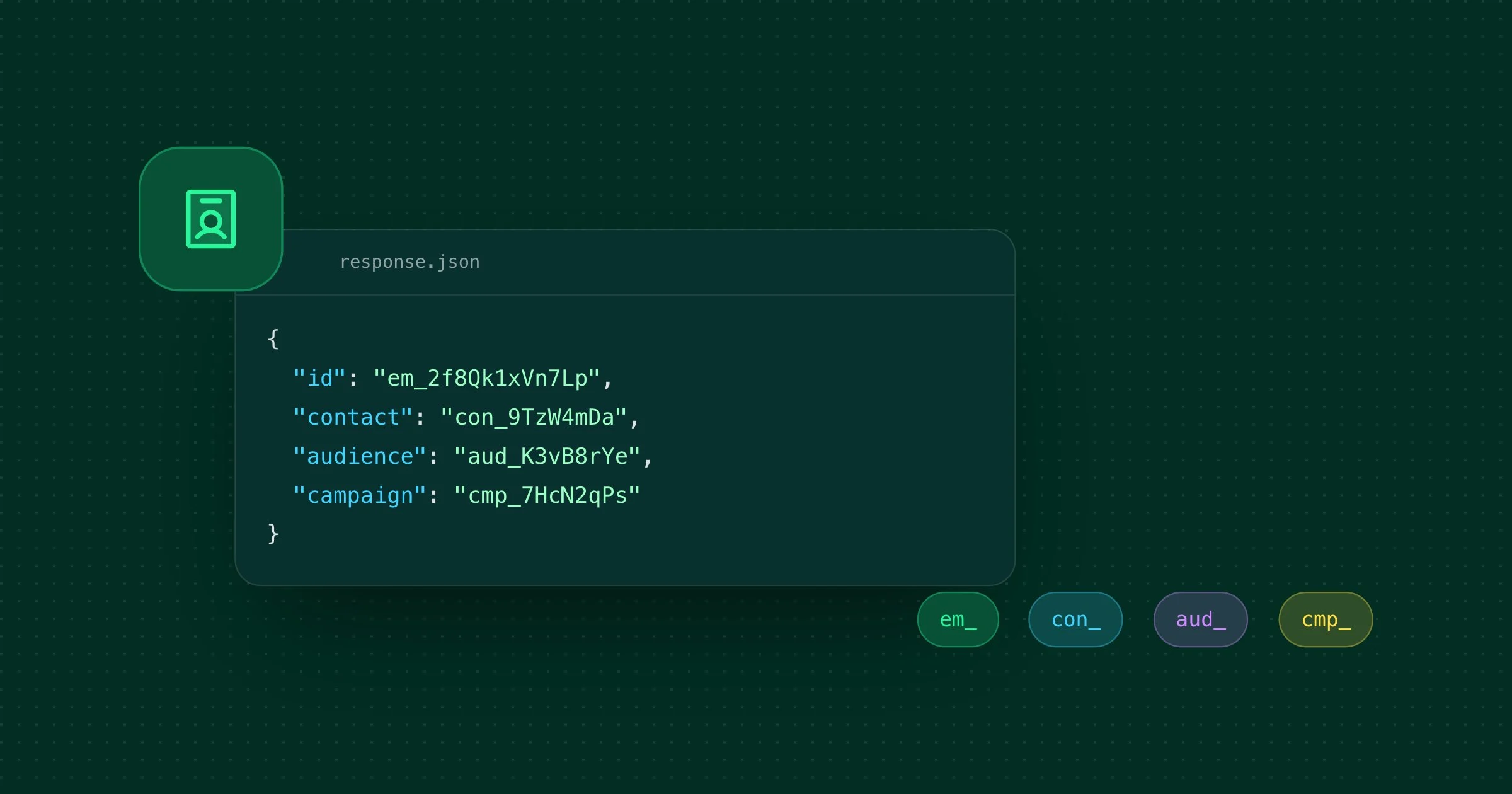
We've transitioned to Object IDs across all entities. This change improves readability, enables independent ID generation across services, and ensures uniqueness at scale.
What are Object IDs?
Object IDs are unique identifiers with a prefix that indicates the entity type. Instead of a generic ID like 12345 or a UUID, you get something like:
em_48klx31D1jqAfDcG53R8y1j1XbPThe em_ prefix tells you immediately that this is an email entity.
Benefits
- Readable — Know the entity type at a glance
- Unique — No collisions across services
- Ordered — IDs are sortable by creation time
- Scalable — Generated independently without database coordination
Entity prefixes
- Audiences —
aud_ - Campaigns —
cmp_ - Clicks —
click_ - Contacts —
con_ - Credentials —
key_ - Custom Fields —
cf_ - Deliveries —
del_ - Emails —
em_ - Events —
evt_ - Files —
file_ - Links —
link_ - Loads —
load_ - Queued Emails —
que_ - Domains —
dom_ - Subscribers —
sub_ - Suppressions —
sup_ - Unsubscribes —
uns_ - Webhook Requests —
whr_ - Webhooks —
wh_
Migration complete
We've migrated over 1.5 billion records to the new Object ID format. All API v2 responses now return Object IDs for the entities listed above.